Wordle gives people a small, understandable task and a result they can discuss. Its daily puzzle and recognisable sharing format offer useful design questions for founders. They do not prove that adding a streak or a share button will make another product grow.
In this article
Watch the story
The Short introduces the story. The article checks the specific claims it discusses; other statements in the video are not all independently verified here.
Subscribe to Vibe Economies on YouTube ↗A bounded task with a clear finish
The original daily format asks players to find a five-letter word within six attempts. Josh Wardle discussed the game and its sale in a February 2022 interview with TIME. The New York Times announced its acquisition in January 2022, reported by Axios.
Our design reading starts with the finish. A player knows when the attempt is over and does not need a tutorial about a large feature set. That can make a small product easier to fit into someone’s day. It also limits the session, so it would be a mistake to judge the design only by how long someone stays on the page.
Sharing can preserve the next person’s experience
The familiar coloured result grid communicates an attempt without spelling out the answer. As a design pattern, this separates showing progress from spoiling the task. Another player can recognise the format and compare the experience while retaining a reason to play.
This is qualitative product analysis, not a measured claim about what proportion of Wordle’s growth came from sharing. To establish that, we would need acquisition and referral data. The existence of a shareable result alone does not reveal the size of its contribution.
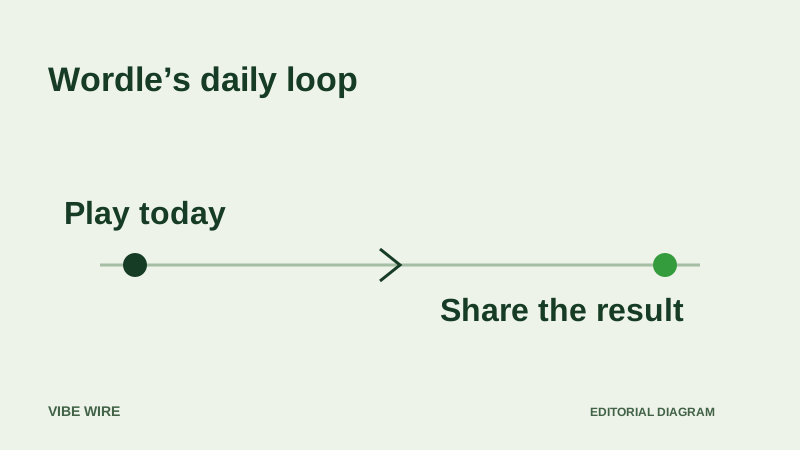
- Understand the taskThe player knows what to attempt and when it ends.
- Complete or exhaust the attemptThe result has meaning without requiring a long explanation.
- Choose to shareThe result gives someone else context without completing the task for them.
- Return for another puzzleThe daily cadence creates a fresh occasion to play.
Borrow the question, not the entire mechanic
For your product, ask what a user would genuinely want to show another person. A finished design, a useful calculation or a completed challenge can be more meaningful than a generic invitation. The shared object should explain enough to be understood outside the app and respect private information.
A daily schedule only makes sense when the underlying task supports it. Payroll software should not manufacture a daily obligation simply because a puzzle does. A research product might have a weekly review rhythm; a utility might be most valuable precisely because people can finish and leave.
Likewise, a streak can motivate some users and burden others. Test whether people return because the next task is worthwhile. Avoid interpreting repeated visits as evidence of satisfaction without asking what users accomplish.
A practical experiment for a small team
Choose one completed task and design a shareable output for it. Explain what the output means, make sharing optional and remove personal details by default. Watch a few people encounter it without your explanation. Can they identify the product’s purpose and decide whether it is relevant?
Measure the steps separately: task completion, voluntary sharing, recipient visits and recipients completing their own task. This is a proposed test plan, not an experiment we have run or a forecast of conversion rates.
For the earlier stage of explaining a product, read the Dropbox demo playbook. For a different social format, see Among Us’s launch history. The appropriate rhythm depends on the experience you are building.
Sources and scope
Sources reviewed October 17, 2026. Company statements are attributed to their issuers. Practical frameworks and interpretations are Vibe Wire’s analysis, not measured outcomes or financial advice.