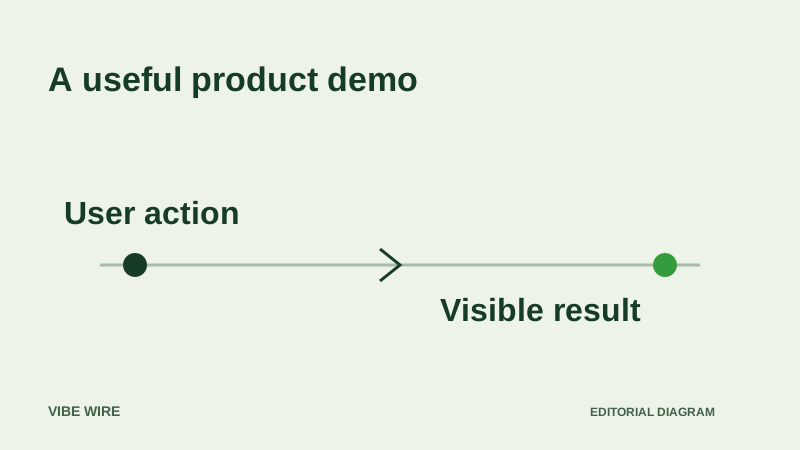
A product demo earns attention when someone can see what becomes easier. Dropbox is a useful example because file synchronisation has a concrete before-and-after result. For a new founder, the task is to make that result understandable and then test whether viewers want to use it.
In this article
Watch the story
The Short introduces the story. The article checks the specific claims it discusses; other statements in the video are not all independently verified here.
Subscribe to Vibe Economies on YouTube ↗What the historical record supports
Dropbox’s 2018 account of Drew Houston’s TechCrunch interview traces his journey from an early demo in 2008 to the company’s IPO. It supports using the demo as a milestone in the company story. It does not provide a controlled measurement of how much that video alone contributed to later growth.
We therefore leave out unsourced waitlist multipliers and claims that a single video proved an entire business. A compelling demonstration can test whether people understand an outcome. It cannot, on its own, demonstrate reliability, willingness to pay or long-term retention.
Make the result observable
Dropbox’s current sync documentation explains the practical concept of keeping files accessible across devices. Use the concept to design a demonstration, but do not assume today’s product is identical to the 2008 version.
- Show the starting problemA person needs the current file on another device.
- Perform one actionAdd or change a clearly named file.
- Show the outcomeMake the matching file and its state visible on the other device.
- Offer a next stepLet the viewer try a relevant task or join a clearly described test.
This is an illustrative storyboard for a sync product, not a reconstruction of the original Dropbox video. Keep recordings honest: disclose simulated behaviour, edits that remove waiting, and features that are not yet available.
Choose a task instead of listing features
A viewer should be able to finish the sentence: “I could use this when…” If the answer is vague, replace the feature tour with a specific task. For a scheduling app, show someone arranging a real meeting. For a research tool, show how it finds and preserves a source a user can inspect.
Keep the visible evidence proportionate to the promise. An animated mock-up is useful for communicating an interface idea, but it is not proof that a backend works. A recorded happy path is not proof that the system handles conflicts or errors. Put those limits close to the demonstration.
Measure what happens after watching
Decide in advance what a meaningful response looks like. A qualified person completing the intended task tells you more than a broad audience clicking a play button. Ask testers to describe what they expected, where they became uncertain and whether the result would replace an existing workaround.
Track the steps separately: video viewed, trial started, task completed, and return visit. If people watch but never try, the offer or audience may be wrong. If they try but cannot finish, investigate the product. These are diagnostic questions, not guaranteed explanations.
Use a small, repeatable test before producing a more elaborate launch film. Our pre-sale guide covers a different form of evidence: whether a clear offer produces genuine commitment. Neither a famous demo nor a polished landing page removes the need to observe customers.
Sources and scope
Sources reviewed October 17, 2026. Company statements are attributed to their issuers. Practical frameworks and interpretations are Vibe Wire’s analysis, not measured outcomes or financial advice.