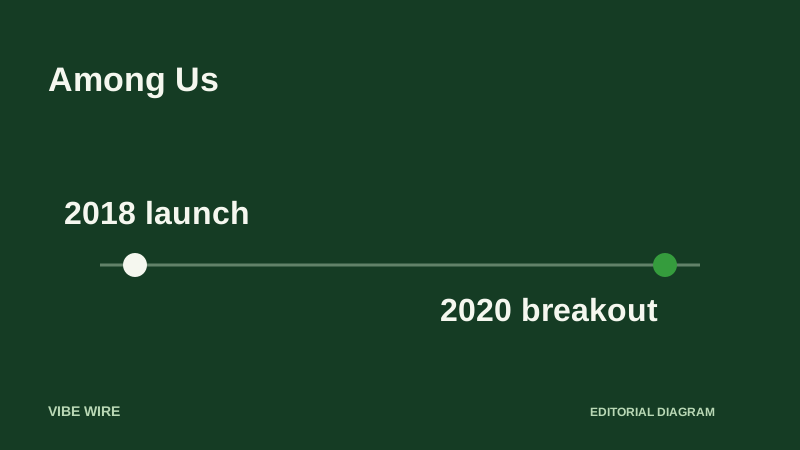
Among Us launched in June 2018 and reached worldwide popularity in summer 2020. In between, Innersloth added to the game and changed how people could play together. Its history is more useful as a study of product and distribution than as a promise that any quiet launch will eventually become a hit.
In this article
Watch the story
The Short introduces the story. The article checks the specific claims it discusses; other statements in the video are not all independently verified here.
Subscribe to Vibe Economies on YouTube ↗The game did not stand still for two years
Innersloth’s official press kit dates the release to June 15, 2018. It describes an initially local-only mobile game made by a three-person team, followed by improvements including online play, maps and cosmetics. The team considered it complete in January 2020, before its summer surge brought renewed work.
That sequence prevents two misleading interpretations: that success arrived immediately, or that nothing changed while the team waited. Release date, product development and widespread discovery are separate events. A founder can control some of those decisions without controlling the timing of public attention.
A timeline for the launch story
- June 2018The original game launches.
- Before the breakoutThe team adds online play and other improvements.
- January 2020Innersloth considers the game complete.
- Summer 2020Worldwide popularity leads the team to resume work.
These milestones come from Innersloth’s account. They do not isolate the contribution of each feature or distribution channel to the later growth.
Why a social game can travel through video
Our product analysis starts with the experience: a group tries to complete tasks while identifying hidden impostors. A viewer can follow accusations, mistakes and reversals without first mastering a complex interface. That makes the behaviour of the people playing part of the entertainment.
For a builder, the useful question is what another person can understand from watching someone use the product. Some products produce an obvious result; others require a before-and-after explanation. A demo that makes the outcome legible gives an audience something concrete to discuss. It still needs a way to reach that audience.
This is an interpretation of the product format, not a measured explanation of the 2020 growth curve. We are not attributing a percentage of the breakout to streamers, timing or any single design choice.
What to do after a quiet launch
Separate weak discovery from weak retention. If few people encounter the product but those who do return, investigate distribution and onboarding. If people arrive and quickly leave, more publicity may magnify a product problem. Talk to users about the last session they completed, rather than asking whether they like the idea.
Set a review date and a budget for the next iteration. Decide what evidence would justify more work and what would make you stop. Among Us is a surviving success story; it cannot tell us how many similar projects never found an audience. Copying the waiting period is therefore a poor plan.
A useful next experiment might make the first multiplayer session easier to organise, improve an invitation, or shorten the explanation a new player needs. Choose one friction point you can observe. For a contrasting daily-play format, read our Wordle design analysis.
Sources and scope
Sources reviewed October 17, 2026. Company statements are attributed to their issuers. Practical frameworks and interpretations are Vibe Wire’s analysis, not measured outcomes or financial advice.