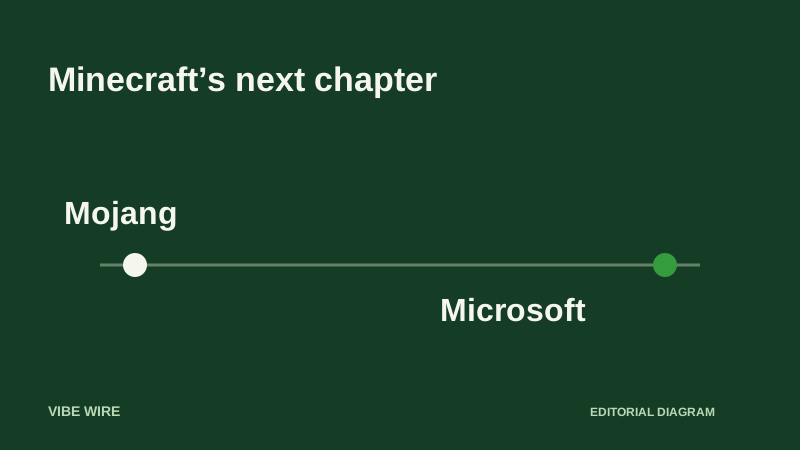
Microsoft’s 2014 agreement to acquire Mojang valued the transaction at $2.5 billion. The announcement centred on Minecraft’s community and continued availability across platforms. That makes it a useful case for asking what allows a product to outlast a change in ownership.
In this article
Watch the story
The Short introduces the story. The article checks the specific claims it discusses; other statements in the video are not all independently verified here.
Subscribe to Vibe Economies on YouTube ↗What Microsoft announced
On September 15, 2014, Microsoft announced an agreement to buy Mojang and the Minecraft franchise. It expected closing later that year, subject to the usual conditions and review. The notice said Microsoft planned to keep Minecraft available on the platforms then supported, including competing consoles and mobile systems.
The $2.5 billion figure describes the acquisition agreement. It is not proof that one creator personally received that amount. A personal-proceeds calculation would need the ownership and transaction details, as well as any relevant deductions.
The community was part of the product story
Microsoft’s announcement repeatedly discussed Minecraft’s players and their activity. Our interpretation is that the buyer was evaluating a product with relationships already built around it. A game people return to and use creatively presents a different opportunity from an isolated piece of software with no continuing audience.
That does not mean community can be owned in the same way as code. Players decide whether to stay. A change in ownership can preserve the experience they value or alter it in ways that weaken their interest. The initial promise to maintain platforms is therefore meaningful as a commitment, even though the announcement cannot prove every later outcome.
Four layers to examine in a franchise
| Layer | Question |
|---|---|
| Core product | What do people repeatedly come back to do? |
| Community | What do users create or organise around it? |
| Distribution | Where can existing and new users access it? |
| Stewardship | Who maintains the product and communicates changes? |
This is an editorial framework, not a valuation model. It helps identify what needs to survive an ownership transition without putting an invented price on each layer.
Do not confuse a creator story with a complete company history
A short founder film can introduce the person who started a product. A durable business also involves colleagues, commercial agreements and people who maintain it after the founder leaves. Keeping those roles visible makes the story more useful for readers trying to build something themselves.
We do not infer the creator’s private motives or wellbeing from the acquisition price. A financial transaction is evidence about a deal, not a diagnosis of someone’s personal life. The relevant business question here is how the product and its users were meant to be supported.
For a small team, document the systems another person would need to operate: releases, customer support, permissions, billing and recovery from failure. Reducing dependence on one founder can make a product easier to maintain even when no sale is planned.
Compare Among Us’s delayed breakout for another game whose audience shaped the work required from its team. Neither case provides a formula for producing a hit, but both make the obligations after launch visible.
Sources and scope
Sources reviewed October 17, 2026. Company statements are attributed to their issuers. Practical frameworks and interpretations are Vibe Wire’s analysis, not measured outcomes or financial advice.