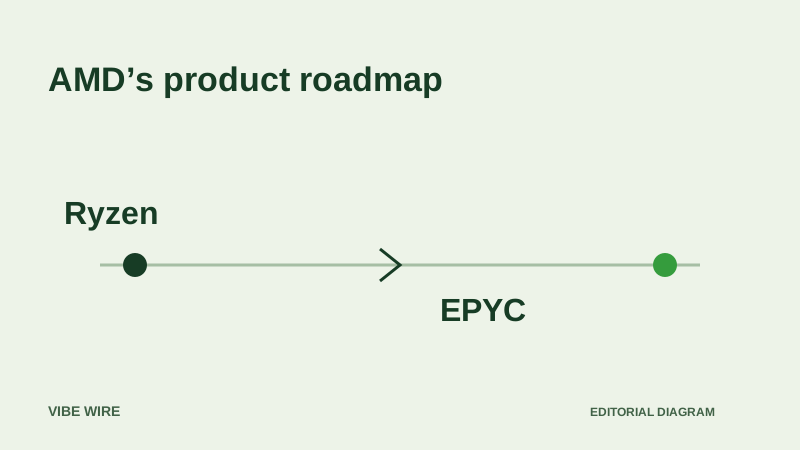
AMD’s turnaround is easier to understand through the products it brought to market than through a stock-price chart. Ryzen returned attention to desktop CPUs in 2017; EPYC extended the story into servers. Those launches give us concrete milestones for examining execution under Lisa Su.
In this article
Watch the story
The Short introduces the story. The article checks the specific claims it discusses; other statements in the video are not all independently verified here.
Subscribe to Vibe Economies on YouTube ↗Start with products customers could evaluate
AMD’s Ryzen 7 announcement set worldwide availability for March 2, 2017. It described the new Zen-based desktop processors and identified Su as president and CEO. The release made performance and pricing claims that buyers could subsequently test in particular workloads.
That distinction is important when reading a turnaround narrative. A new architecture is a technical and commercial proposition; shipping a product lets customers assess it. A company’s launch benchmarks remain vendor claims, not an independent verdict covering every application.
The server business asks a different question
On June 20, 2017, AMD launched the EPYC 7000 series with server partners. The announcement linked processors to a wider ecosystem of platforms. A processor designed for servers must be assessed in the system a buyer actually deploys.
| Product context | Useful buyer questions |
|---|---|
| Desktop processor | Does it improve my workload at an acceptable total system price? |
| Server platform | Can it run the required software reliably, with support and manageable operating costs? |
| Future roadmap | Can I plan upgrades without assuming every launch promise will arrive on time? |
The questions are our comparison framework. They are not a claim that AMD won every benchmark or contract.
A turnaround needs more than a compelling leader
Founder and executive videos naturally centre on a person. Products require engineering teams, manufacturing relationships, software support and commercial execution as well. Treating a multi-year result as one individual’s decision can hide the operating work a reader most needs to understand.
Our interpretation is that the 2017 launches provide a useful way to study consistency: establish a technical direction, deliver a product customers can test, and support additional markets without losing the original promise. That does not establish that these launches alone caused every later financial result.
A serious assessment would also compare financial statements, margins, customer adoption and competitors over the same period. A rising market capitalisation cannot substitute for that work, particularly when the article’s subject is product strategy rather than investment performance.
Apply the lesson at a smaller scale
A small software team can borrow the discipline without pretending to have a semiconductor company’s resources. Choose the workload you will improve, state how a customer can test it, and identify the dependencies needed to deliver. A prototype that works once and a service that can be supported are different milestones.
Write the next release promise narrowly enough to verify. Record what shipped, what changed and what customers still cannot do. That creates a more useful history than a retrospective story in which every decision looks inevitable.
For another business that outgrew its original creator, see Minecraft’s move to Microsoft. Both stories invite a closer look at the organisation around the product.
Sources and scope
Sources reviewed October 17, 2026. Company statements are attributed to their issuers. Practical frameworks and interpretations are Vibe Wire’s analysis, not measured outcomes or financial advice.