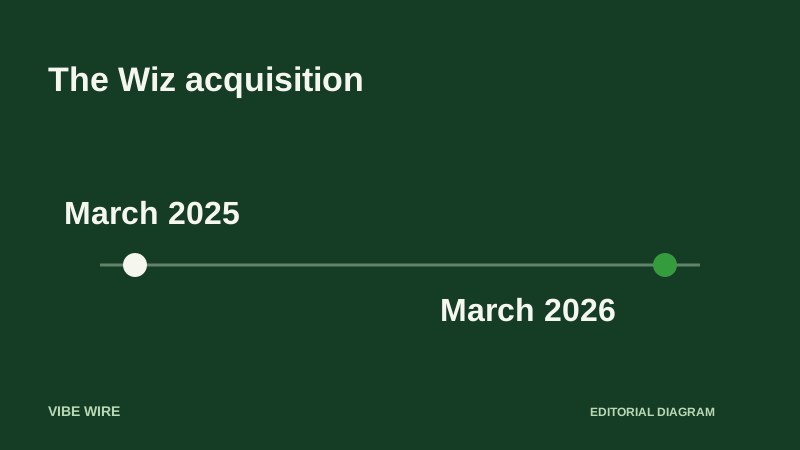
Google bought Wiz to expand its cloud-security business. The agreement was announced in March 2025; completion came on March 11, 2026. Keeping those dates separate makes the story much clearer than a single headline about a $32 billion exit.
In this article
Watch the story
The Short introduces the story. The article checks the specific claims it discusses; other statements in the video are not all independently verified here.
Subscribe to Vibe Economies on YouTube ↗What did Google agree to buy?
Google’s March 2025 announcement described a $32 billion all-cash agreement, subject to closing adjustments and approvals. Its March 2026 completion notice says Wiz joined Google Cloud while retaining its brand and support for other cloud environments.
A signed agreement sets out a proposed transaction. Closing is the point at which the transaction completes under its conditions. Neither event tells us how much an individual founder received after the ownership split, obligations and taxes. The price belongs to the company transaction.
The timeline that belongs beside the headline
- March 2025Google announces the $32 billion agreement. Completion is still conditional.
- March 11, 2026Google announces completion. Wiz joins Google Cloud.
- After closingIntegration and delivery become the operating questions. An announcement cannot establish the eventual return on the purchase.
The two dated Google announcements support the first two events. The final step is our interpretation of what to watch next. Older videos remain useful introductions, but their language about a future deal should be read against the completion notice.
Why support rival clouds?
Google explicitly says Wiz will continue to work across Amazon Web Services, Microsoft Azure, Oracle Cloud and Google Cloud. That commitment is central to the acquisition rationale: customers can have security problems spanning several providers. A tool restricted to the buyer’s own infrastructure would address a narrower problem.
Our reading is that distribution and trust must work together here. Google can introduce Wiz through its enterprise relationships, but customers still need confidence that their existing infrastructure will remain supported. The commercial promise depends on usefulness across that mixed environment. It is not evidence that every customer will consolidate its security spending.
How to assess a strategic acquisition
Start with the buyer’s missing capability. Ask whether buying gives it technology, customer access, specialist people or a combination. Then look at what the buyer promises to preserve. Brand independence, compatibility and partner relationships can matter as much as a product integration diagram.
For a smaller software company, the useful question is which expensive customer problem its product owns. A long feature list gives a potential buyer less information than evidence that customers repeatedly rely on a particular workflow. Retention, deployment effort and the cost of replacing that workflow deserve attention before speculative exit prices.
Finally, separate the seller’s result from the buyer’s result. A completed transaction confirms a change of ownership. Whether Google earns an attractive return will depend on outcomes after closing. Read how ownership differs from founder proceeds before translating an acquisition headline into a personal fortune.
Sources and scope
Sources reviewed October 17, 2026. Company statements are attributed to their issuers. Practical frameworks and interpretations are Vibe Wire’s analysis, not measured outcomes or financial advice.