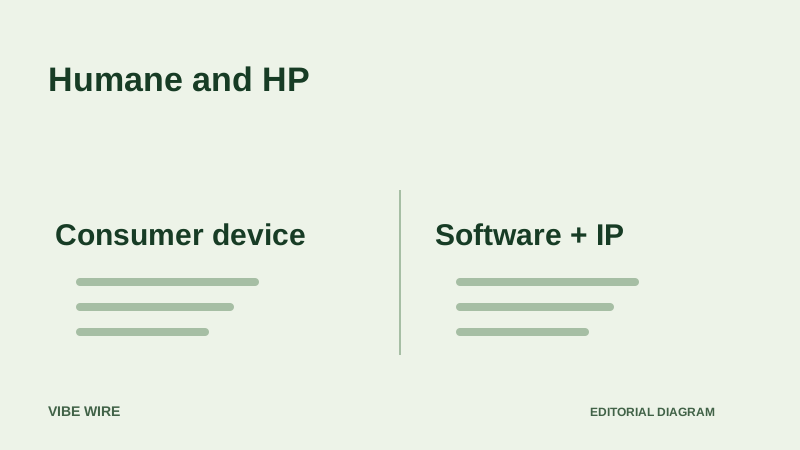
HP’s February 2025 announcement concerned specific Humane capabilities: the Cosmos platform, technical talent and intellectual property. Treating that as a simple purchase of the consumer AI Pin business obscures what HP actually described buying.
In this article
Watch the story
The Short introduces the story. The article checks the specific claims it discusses; other statements in the video are not all independently verified here.
Subscribe to Vibe Economies on YouTube ↗Read the object of the transaction
In its February 18, 2025 release, HP announced a definitive agreement worth $116 million. It listed Cosmos, technical staff and more than 300 patents and patent applications. HP said the engineers would form HP IQ within its technology organisation.
The release expected closing at the end of that month. An expectation in an announcement is not a completion notice. This article examines what the agreement covered; it does not use that release to certify a closing date, customer refund policy or the exact shutdown timeline of the AI Pin service.
A product can have several kinds of value
| Part | What a buyer or customer evaluates |
|---|---|
| Consumer device | Whether the complete experience is useful enough to buy and keep |
| Software platform | Whether capabilities can support other products |
| Technical team | Specialist knowledge and ability to deliver |
| Intellectual property | The rights and applications included in the agreement |
These categories help interpret HP’s announcement. They do not assign a separate dollar value to each asset. A patent application is also not automatically a granted patent, so the combined count should retain both terms.
What the transaction does not tell us
A sale price for selected assets cannot establish whether earlier investors recovered their capital. It does not reveal the order of claims, outstanding obligations or proceeds received by particular founders. It also does not prove that the consumer device had achieved a sustainable market.
Conversely, the experience of a consumer product does not make every underlying component worthless. Our interpretation is that an acquirer can find a different use for software and expertise. Whether that use succeeds requires evidence from the buyer’s later products, not just enthusiasm in a transaction announcement.
That is why “company sold” is often too vague. Ask whether the transaction involves shares, selected assets, a team, licences or several of those together. The answer changes what the headline means.
A launch checklist for connected hardware
Before buying or building a connected device, separate what runs locally from what depends on a remote service. Ask what happens during a network failure, whether data can be exported, and what support exists if the service ends. Those questions belong in a product review alongside the demonstration.
For a builder, test the whole daily routine: carrying the device, charging it, invoking a task, correcting an error and recovering when it cannot help. A persuasive stage demo covers only a small part of that experience. This checklist is our recommendation; it is not an account of tests we ran on the AI Pin.
Compare this with Jony Ive and OpenAI’s announced collaboration. In both stories, distinguish the people and capabilities involved from evidence that a specific consumer product is ready or successful.
Sources and scope
Sources reviewed October 17, 2026. Company statements are attributed to their issuers. Practical frameworks and interpretations are Vibe Wire’s analysis, not measured outcomes or financial advice.