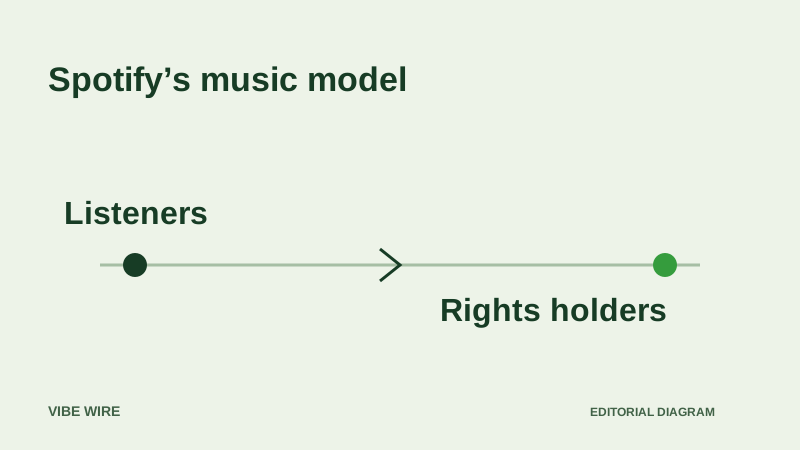
Spotify earns revenue from subscriptions and advertising. Music rights holders receive a large share of the music revenue, while Spotify must cover its remaining costs from what it retains. Subscriber growth alone does not tell you the company’s profit or an artist’s income.
In this article
Watch the story
The Short introduces the story. The article checks the specific claims it discusses; other statements in the video are not all independently verified here.
Subscribe to Vibe Economies on YouTube ↗Two ways listeners support the business
Premium customers pay for subscriptions; advertisers pay to reach listeners on the free service. Spotify describes both revenue sources in its royalty explanation. The economic relationship differs: one depends on a listener maintaining a paid plan, the other on selling advertising around listening.
When analysing a subscription business, distinguish the customer count from the amount earned per customer. Discounts, plan mix and geography can change the second measure while the first rises. A user total also needs a definition: a free listener and a paid subscriber are not interchangeable units of subscription revenue.
Follow the payment, not a supposed fixed rate
Spotify says roughly two-thirds of its music revenue goes to rights holders. Its royalties guide separates recording and publishing royalties and explains that payments reach rights holders before artists and songwriters receive their contractual shares. That is different from a universal payment sent directly to each performer for every play.
| Stage | What changes hands | What to avoid assuming |
|---|---|---|
| Listener or advertiser | Subscription or advertising payment | Every user generates the same revenue |
| Spotify to rights holders | Recording and publishing royalties | There is one fixed artist rate per stream |
| Rights holder to creator | Payment under the creator’s agreements | The rights-holder payment equals take-home income |
The flow is a simplified explanation, not a calculation for an individual artist’s contract.
Why the retained share is not net profit
A business still has people, product development, marketing and other expenses after paying for the content it distributes. The remaining share of music revenue therefore cannot be read as net profit. Spotify’s financial reports are the place to compare revenue, cost of revenue, operating expenses and the reporting period.
Keep the units consistent when making that comparison. An annual revenue figure cannot be set beside a quarterly expense and treated as a margin. Nor should music-specific royalty guidance be used as an exact breakdown of every podcast, audiobook or advertising arrangement within the company.
The founder lesson: price the whole service
Our analysis for builders is straightforward: estimate the cost that grows when a customer uses the product, then include the cost of operating the company. A subscription can look attractive before usage costs and support are counted. It can also improve with scale without becoming costless to deliver.
For a hypothetical content app, write down subscription receipts, content fees, payment processing, hosting and support separately. Test what happens when heavy users become a larger share of customers. The purpose is to understand sensitivity, not copy Spotify’s royalty percentage into an unrelated business.
Daniel Ek’s founder story opens the subject, but a useful business-model analysis follows the money beyond the headline. Our software-budget guide applies that same discipline to smaller teams.
Sources and scope
Sources reviewed October 17, 2026. Company statements are attributed to their issuers. Practical frameworks and interpretations are Vibe Wire’s analysis, not measured outcomes or financial advice.